
|
Getting your Trinity Audio player ready...
|
Overview
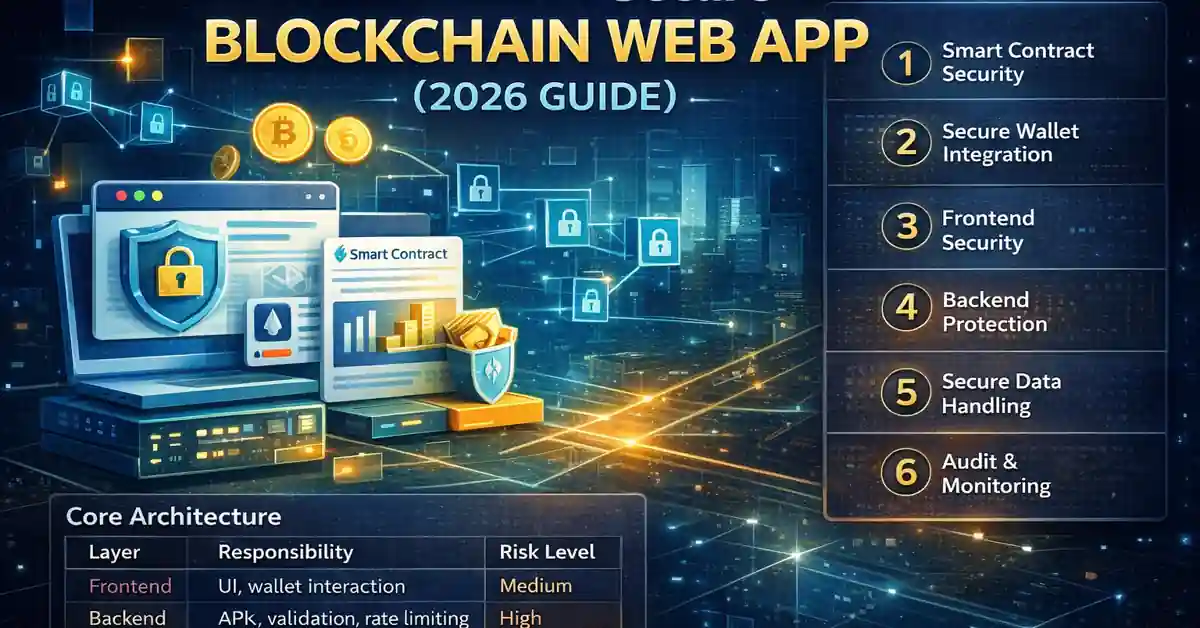
Building a blockchain-based web application is not just about smart contracts. Security must be enforced across frontend, backend, wallet interaction, and on-chain logic. One weak layer can expose the entire system.

Core Architecture
| Layer | Responsibility | Risk Level |
|---|---|---|
| Frontend | UI, wallet interaction | Medium |
| Backend | APIs, validation, rate limiting | High |
| Smart Contract | Business logic on-chain | Critical |
| Wallet | Signing transactions | Critical |
1. Smart Contract Security
Smart contracts are immutable. Bugs cannot be patched easily.
Best Practices
- Use audited libraries like https://docs.openzeppelin.com/contracts
- Avoid reentrancy attacks (use checks-effects-interactions pattern)
- Limit admin privileges
- Add fail-safe pause mechanism
Example (Reentrancy Guard)
contract Secure {
    bool locked;

    modifier noReentrant() {
        require(!locked, "No reentrancy");
        locked = true;
        _;
        locked = false;
    }
}
2. Secure Wallet Integration

Never handle private keys on your server.
Use Trusted Wallets
Rules
- Always verify network (chain ID)
- Prompt user before every transaction
- Avoid auto-sign flows
3. Frontend Security
Frontend is often ignored but attackers target it heavily.
Key Measures
- Sanitize inputs to prevent XSS
- Use HTTPS only
- Implement Content Security Policy (CSP)
Example CSP
<meta http-equiv="Content-Security-Policy" content="default-src 'self'; script-src 'self' https://trusted.cdn.com;">
4. Backend Protection (If Used)
Even in Web3, backend APIs are used for indexing and analytics.
Must Implement
- Rate limiting
- JWT authentication
- Input validation
Recommended Tools
5. Secure Data Handling
Do NOT store sensitive data on-chain.
| Data Type | Storage Location |
|---|---|
| Public data | Blockchain |
| Private data | Encrypted DB |
| Files | https://ipfs.tech |
6. Smart Contract Testing
Testing is mandatory before deployment.
Tools
What to Test
- Edge cases
- Gas limits
- Attack simulations
7. Audit & Monitoring
Before going live, run a professional audit.
Audit Platforms
Monitoring
- Track transactions
- Detect unusual patterns
- Set alerts for large withdrawals
Common Vulnerabilities
| Vulnerability | Description | Fix |
|---|---|---|
| Reentrancy | Recursive contract calls | Use guards |
| Integer Overflow | Math overflow errors | Use SafeMath |
| Phishing UI | Fake frontend | Verify domain + SSL |
| Private Key Leak | User compromise | Never store keys |
FAQ
1. Do I need a backend in Web3?
Optional, but useful for performance and indexing.
2. Which blockchain is best for secure apps?
Ethereum is widely used due to strong ecosystem and tooling.
3. Can smart contracts be updated?
Only if designed using proxy patterns.
Final Take
Security in blockchain apps is multi-layered. Smart contracts, wallet interaction, and frontend must all be hardened together. Skipping even one layer creates a vulnerability.
Focus on audits, testing, and minimal trust architecture.

Arsalan Malik is a passionate Software Engineer and the Founder of Makemychance.com. A proud CDAC-qualified developer, Arsalan specializes in full-stack web development, with expertise in technologies like Node.js, PHP, WordPress, React, and modern CSS frameworks.
He actively shares his knowledge and insights with the developer community on platforms like Dev.to and engages with professionals worldwide through LinkedIn.
Arsalan believes in building real-world projects that not only solve problems but also educate and empower users. His mission is to make technology simple, accessible, and impactful for everyone.
Join us on dev community