
|
Getting your Trinity Audio player ready... |
A reverse proxy is not just another server in your stack. It is a traffic controller that sits in front of your backend and decides how requests should be handled.
If users directly hit your origin server, performance and security depend entirely on that machine. A reverse proxy changes this model.
What Is a Reverse Proxy?
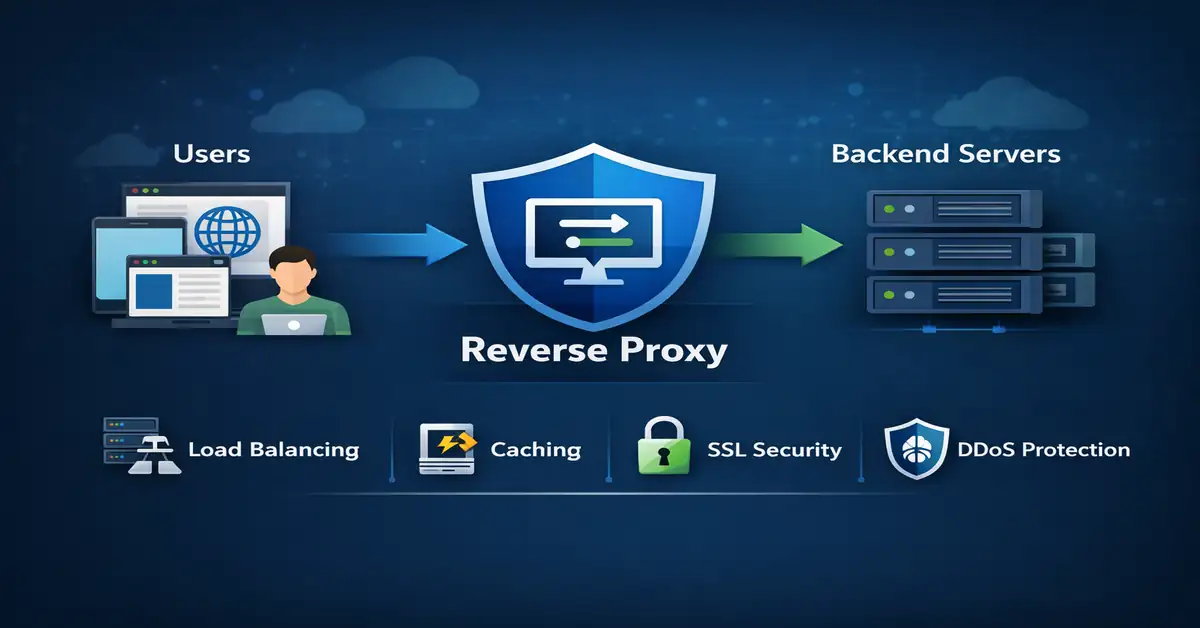
A reverse proxy is an intermediate server placed between clients (browsers) and your backend server.
Instead of:
User → Backend Server
The flow becomes:
User → Reverse Proxy → Backend Server
The client never directly communicates with the origin server.
Core Technologies Used as Reverse Proxy
Common production-grade reverse proxy servers:
Both Nginx and Apache support reverse proxy configuration modules and are widely used in enterprise deployments.
How It Works (Technical Flow)
- User sends HTTP/HTTPS request.
- DNS points domain to reverse proxy IP.
- Reverse proxy receives request.
- It applies rules (cache, security, routing).
- Forwards request to backend if needed.
- Sends response back to client.
The backend server remains hidden.
Why Reverse Proxy Is Used
1. Performance Optimization
A reverse proxy can cache static and even dynamic content.
If a cached response exists:
- No backend processing
- No database query
- Faster TTFB
This significantly reduces load on application servers.
2. Load Balancing
Traffic can be distributed across multiple backend servers.
Instead of one overloaded server:
Reverse Proxy → Server A
Reverse Proxy → Server B
Reverse Proxy → Server C
This improves scalability and fault tolerance.
3. SSL Termination
HTTPS encryption can be handled at the reverse proxy level.
Benefits:
- Backend servers stay HTTP
- Reduced CPU load on application servers
- Centralized certificate management
4. Security Layer
A reverse proxy hides your real server IP.
It can:
- Filter malicious traffic
- Block bots
- Apply rate limiting
- Protect from DDoS attacks
5. CDN Architecture
Most CDN providers act as distributed reverse proxies.
When using a CDN:
User → Edge Server → Origin Server
Content is served from the nearest edge location.
Reverse Proxy vs Forward Proxy
| Reverse Proxy | Forward Proxy |
|---|---|
| Protects servers | Protects users |
| Used by websites | Used in corporate networks |
| Improves performance | Controls outbound access |
Real-World Example (WordPress / MERN Stack)
WordPress Setup
User → Cloudflare → LiteSpeed → WordPress → MySQL
Cloudflare works as reverse proxy + CDN.
LiteSpeed can also act as a reverse proxy with server-level caching.
MERN Setup
User → Nginx → Node.js → MongoDB
In production, Nginx handles:
- SSL termination
- Rate limiting
- Static file caching
- Load balancing
Node.js focuses only on application logic.
When You Should Use It
You need a reverse proxy if:
- Traffic is growing
- You want better TTFB
- You need load balancing
- You want to hide origin IP
- You are deploying production infrastructure
For small local projects, it may not be required.
Final Summary
A reverse proxy is a mandatory layer in modern production systems. It improves performance, scalability, and security without modifying your application code.
It is an infrastructure-level optimization layer.
If your backend is directly exposed to the internet, your architecture is incomplete.

Arsalan Malik is a passionate Software Engineer and the Founder of Makemychance.com. A proud CDAC-qualified developer, Arsalan specializes in full-stack web development, with expertise in technologies like Node.js, PHP, WordPress, React, and modern CSS frameworks.
He actively shares his knowledge and insights with the developer community on platforms like Dev.to and engages with professionals worldwide through LinkedIn.
Arsalan believes in building real-world projects that not only solve problems but also educate and empower users. His mission is to make technology simple, accessible, and impactful for everyone.
Join us on dev community