
|
Getting your Trinity Audio player ready... |
As developers, we don’t care about buzzwords.
We care about what runs in production, what breaks, what costs money, and what silently gives wrong answers.
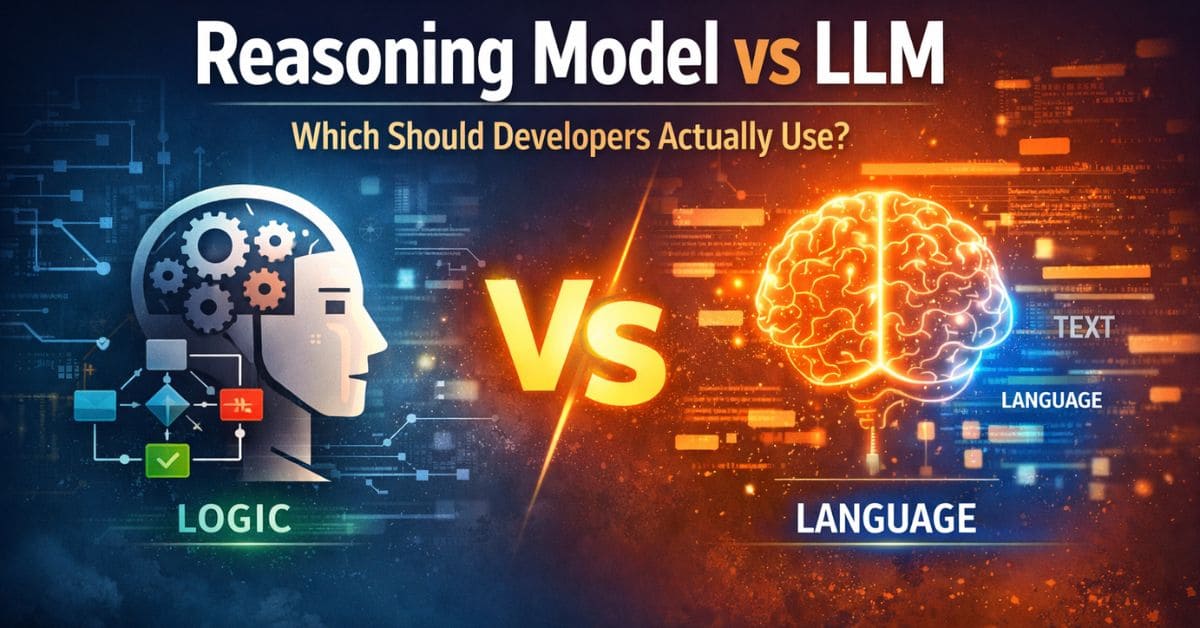
Right now, a lot of teams are confused between Reasoning Models and LLMs. They look similar from the outside (same REST call, same JSON), but internally they behave very differently.
This article is a developer-to-developer breakdown—no hype, no AI marketing language—just how these models actually work and when you should (or should not) use them.

What an LLM Actually Does (From a Dev’s Perspective)
A Large Language Model (LLM) is fundamentally a probabilistic next-token generator.
It doesn’t “think.”
It doesn’t “reason.”
It predicts what token should come next based on patterns it learned from massive text corpora.
If you want a formal explanation, here’s a good neutral overview of a Large Language Model (LLM).
What this means in practice
An LLM is extremely good at:
- Text generation
- Summarization
- Code autocomplete
- Translation
- Rewriting and formatting
- Light logic that looks correct
From an API standpoint, it’s simple:
POST /chat/completions
{
  "model": "llm-model",
  "messages": [
    { "role": "user", "content": "Explain closures in JavaScript" }
  ]
}
You give text → it gives text back.
Where LLMs quietly fail
LLMs:
- Don’t verify answers
- Don’t run internal checks
- Will confidently hallucinate
- Can contradict themselves in long contexts
For content-heavy systems, that’s usually fine.
For logic-heavy systems, that’s dangerous.
What a Reasoning Model Actually Does
A reasoning model is optimized to explicitly reason through steps, not just generate fluent text.
Instead of jumping directly to the answer, it internally:
- Breaks the problem into steps
- Evaluates constraints
- Tracks intermediate states
- Verifies logical consistency
Here’s a solid general explanation of a Reasoning model if you want the theory side.
Why reasoning models feel “slower”
Because they are.
They deliberately spend compute on:
- Step-by-step analysis
- Internal validation
- Self-correction
From a backend perspective, this often means:
- Higher latency
- More tokens consumed
- Higher cost per request
But also:
- Fewer logical errors
- Much better performance on multi-step tasks
How Developers Actually Use LLMs in Real Systems
LLMs shine when the output is language-first, not logic-first.
Common real-world uses
- Blog/article generation
- Code comments & documentation
- UI copy
- Chatbots for support
- Search result explanations
- Converting user intent → structured JSON
Example backend flow:
Client → API Gateway → LLM → Response Formatter → Client
Very little orchestration required.
If the model gets something slightly wrong, it usually doesn’t break the product.
How Developers Use Reasoning Models in Real Systems
Reasoning models are used when wrong answers are worse than slow answers.
Typical use cases
- Multi-step math or finance calculations
- Decision engines
- Planning systems
- Tool-using agents
- Validation-heavy workflows
- Complex code generation with constraints
Backend flow looks more like this:
Client
↓
Controller
↓
Reasoning Model
↓
Tool Calls / Validators
↓
Post-Processing
↓
Client
These systems often combine:
- Reasoning model
- External tools (DBs, APIs)
- Rule-based validation layers
API Flow & Backend Architecture (Reality Check)
LLM-only architecture (simple & fast)
Request → LLM → Response
Pros:
- Cheap
- Low latency
- Easy to scale
Cons:
- No guarantee of correctness
Reasoning-model architecture
Request
→ Reasoning Model
→ Step decomposition
→ Internal checks
→ Tool calls
→ Final Answer
Pros:
- Higher accuracy
- Better consistency
- Safer for critical logic
Cons:
- More tokens
- Higher cost
- More engineering effort
Cost vs Accuracy: The Trade-off Developers Can’t Ignore
| Factor | LLM | Reasoning Model |
|---|---|---|
| Cost per request | Low | High |
| Latency | Fast | Slower |
| Logical accuracy | Medium | High |
| Hallucination risk | High | Low |
| Scaling | Easy | Harder |
| Best for | Language tasks | Logic-heavy tasks |
If you’re serving millions of requests, reasoning models can destroy your budget.
When Reasoning Models Are Overkill
Don’t use a reasoning model if:
- You’re generating blogs or documentation
- You’re rewriting or summarizing text
- You’re building a simple chatbot
- Errors are non-critical
- You can tolerate “mostly correct” output
A lot of teams burn money here just to say they’re using “advanced AI.”
Reasoning Model vs LLM
| Feature | LLM | Reasoning Model |
|---|---|---|
| Core behavior | Pattern completion | Step-by-step reasoning |
| Internal validation | ❌ No | ✅ Yes |
| Token usage | Low | High |
| Best output type | Natural language | Decisions & logic |
| Ideal usage | Content, UI, chat | Planning, logic, tools |
| Production cost | Predictable | Expensive |
Final Take
Most products do NOT need reasoning models.
Use an LLM by default.
Add reasoning models only where correctness matters more than cost.
The best production systems today are hybrids:
- LLM for language
- Reasoning model only for critical paths
That’s how you ship fast and stay sane.
FAQs
Do reasoning models replace LLMs?
No. Reasoning models usually build on top of LLM capabilities. They’re not replacements.
Can I force an LLM to reason better with prompts?
To some extent, yes. But prompt-based reasoning is still fragile compared to dedicated reasoning models.
Are reasoning models worth the cost?
Only if incorrect answers have real consequences (money, safety, trust).
Should startups use reasoning models?
Rarely at the start. Optimize for speed and iteration first.
Is chain-of-thought the same as a reasoning model?
No. Chain-of-thought is a prompting technique. Reasoning models are trained and optimized for reasoning.
Related Reading

Arsalan Malik is a passionate Software Engineer and the Founder of Makemychance.com. A proud CDAC-qualified developer, Arsalan specializes in full-stack web development, with expertise in technologies like Node.js, PHP, WordPress, React, and modern CSS frameworks.
He actively shares his knowledge and insights with the developer community on platforms like Dev.to and engages with professionals worldwide through LinkedIn.
Arsalan believes in building real-world projects that not only solve problems but also educate and empower users. His mission is to make technology simple, accessible, and impactful for everyone.
Join us on dev community