
|
Getting your Trinity Audio player ready... |
The OpenJS Foundation has officially released Node.js 21, introducing the next phase of evolution for the JavaScript runtime. As a Current release, Node.js 21 focuses on modern web compatibility, performance improvements, and developer‑centric tooling rather than long‑term stability.
What’s New in Node.js 21
Node.js 21 continues the project’s shift toward tighter alignment with browser APIs and modern JavaScript standards.
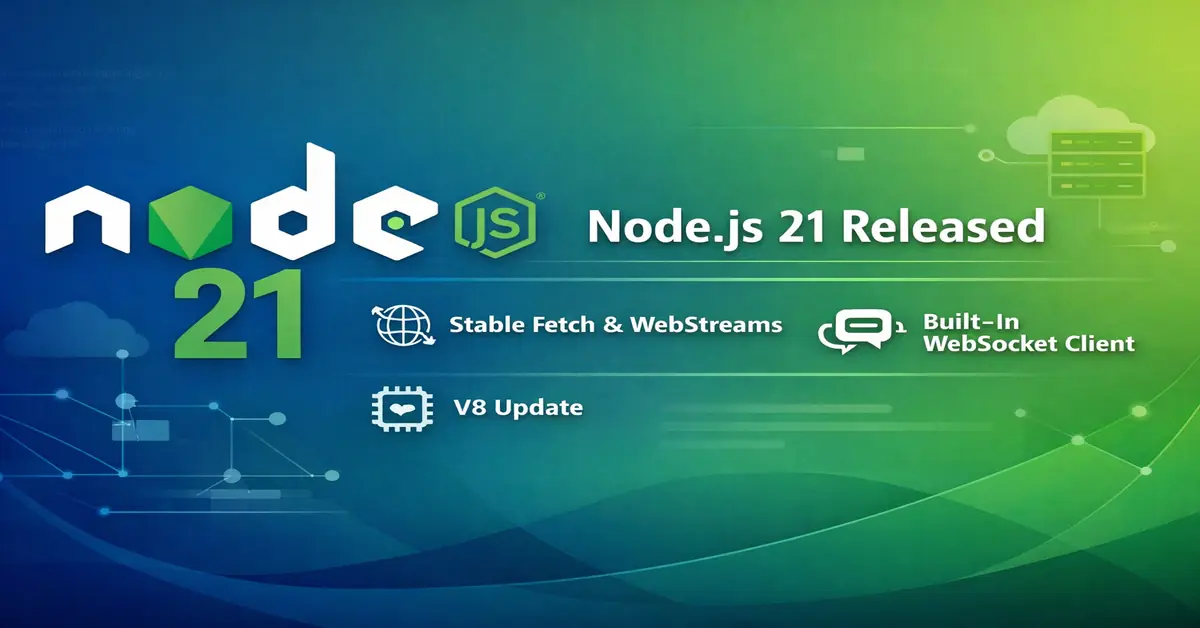
- Improved Web API support: Fetch API and Web Streams are now stable, reducing dependency on third‑party libraries for HTTP requests and streaming.
- Native WebSocket client (experimental): Developers can implement real‑time communication without relying on external WebSocket packages.
- V8 engine upgrade: Node.js 21 ships with a newer V8 version, bringing faster execution and support for the latest ECMAScript features.
- Enhanced test runner: The built‑in Node.js test runner now supports glob patterns, simplifying large‑scale test setups.
- Module system flexibility: New experimental flags make it easier to manage default module behavior in mixed ESM and CommonJS projects.
Release Strategy and Stability
Node.js 21 is a Current release, meaning it is designed for early adopters and production testing rather than long‑term deployments. According to Node.js release policy, odd‑numbered versions receive short‑term support, while even‑numbered versions transition into Long‑Term Support (LTS).
For production systems, LTS versions like Node.js 20 remain the recommended choice. Node.js 21 is best suited for teams evaluating upcoming platform capabilities and preparing for future LTS releases.
Why This Release Matters
Node.js 21 reflects a clear direction: making Node.js a first‑class web platform, not just a server runtime. Built‑in web standards reduce ecosystem fragmentation, simplify onboarding, and bring Node.js closer to the browser execution model.
For web developers, this release signals faster development cycles, fewer dependencies, and better alignment between front‑end and back‑end JavaScript.
External Source

Arsalan Malik is a passionate Software Engineer and the Founder of Makemychance.com. A proud CDAC-qualified developer, Arsalan specializes in full-stack web development, with expertise in technologies like Node.js, PHP, WordPress, React, and modern CSS frameworks.
He actively shares his knowledge and insights with the developer community on platforms like Dev.to and engages with professionals worldwide through LinkedIn.
Arsalan believes in building real-world projects that not only solve problems but also educate and empower users. His mission is to make technology simple, accessible, and impactful for everyone.
Join us on dev community