
|
Getting your Trinity Audio player ready... |
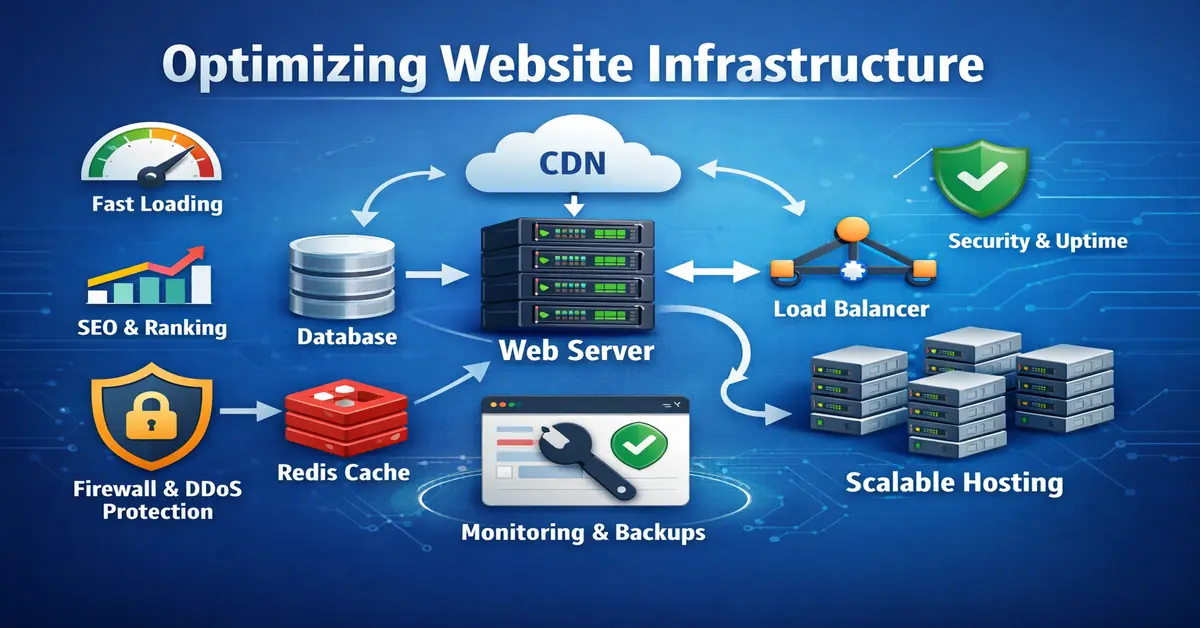
Website infrastructure is not just a hosting decision. It is the complete technical backbone that decides how fast a site loads, how it handles traffic, how secure it is, and how well it performs in search engines. Most website problems—downtime, ranking drops, revenue loss—start from weak or poorly planned infrastructure.
What Website Infrastructure Includes
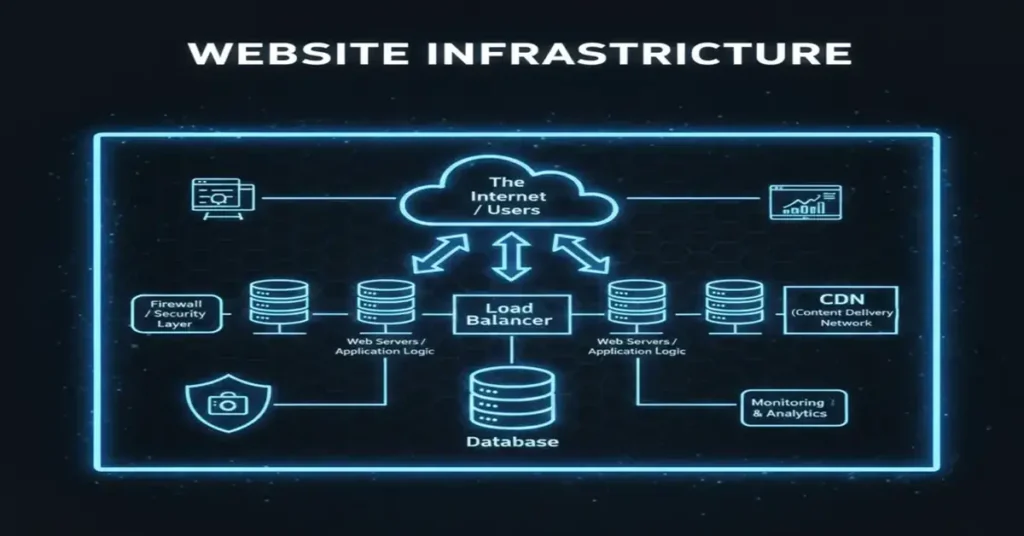
Website infrastructure is a combination of multiple layers working together:
- Hosting server (shared, VPS, cloud, dedicated)
- Web server software (LiteSpeed, Nginx, Apache)
- Database layer (MySQL, MariaDB, PostgreSQL)
- Caching systems (page cache, object cache, Redis, Memcached)
- CDN and DNS (DNS basics, CDN basics)
- Security layers (Web Application Firewall, SSL, firewall, DDoS protection), SSL, firewall, DDoS protection)
- Monitoring and backup systems
If any one layer is weak, the entire website suffers.
Infrastructure Directly Impacts Website Speed
Speed is no longer optional. Infrastructure defines:
A fast theme or optimized images cannot fix a slow server. Shared hosting with overloaded CPUs causes random delays, cache misses, and frequent 5xx errors. Modern infrastructure uses:
- SSD or NVMe storage
- HTTP/2 or HTTP/3
- Server-side caching
- CDN-based delivery
This is critical for both users and Google rankings.
Scalability: Growth Without Downtime
Traffic growth exposes weak infrastructure very quickly. Viral posts, Google Discover traffic, or sudden keyword ranking improvements can crash underpowered servers.
Good infrastructure supports:
- Auto-scaling resources (AWS Auto Scaling)
- Load balancing (what is load balancing)
- Isolated containers or instances
Without this, traffic growth becomes a risk instead of an advantage.
Reliability and Uptime Matter More Than You Think
Frequent downtime damages:
- Search engine trust
- User confidence
- Ad revenue and conversions
Errors like 500, 502, 503, 520, and 524 are usually infrastructure-related, not content-related. A stable setup uses redundancy, health checks, and failover mechanisms to keep the site accessible even during partial failures.
Infrastructure and SEO Are Deeply Connected
SEO is not only about content and backlinks. Google evaluates:
- Server stability
- Crawl success rate (crawl budget)
- Page speed consistency (Core Web Vitals)
If Googlebot repeatedly hits errors or slow responses, crawl budget is wasted. Rankings can drop even when content remains unchanged. Many unexplained traffic drops are infrastructure issues, not algorithm penalties.
Security Starts at the Infrastructure Level
Plugins and code security are secondary layers. Infrastructure is the first defense.
Strong infrastructure includes:
- Web Application Firewall (What is a Web Application Firewall (WAF)))
- DDoS mitigation (DDoS basics)
- Secure server isolation
- Automatic security updates
Weak infrastructure exposes sites to brute force attacks, bot abuse, and malware injections—especially on shared environments.
Caching Depends on Infrastructure Quality
Caching is only effective when infrastructure supports it correctly. Poor server setups cause:
- Cache conflicts
- Object cache corruption
- Stale content delivery
Redis (Redis cache explained), LiteSpeed cache, and CDN caching must be properly aligned. Misconfigured caching layers often lead to critical errors and site crashes.
Cost Efficiency Over the Long Term
Cheap hosting looks attractive initially but costs more over time:
- Lost traffic during downtime
- Emergency fixes and migrations
- SEO recovery efforts
Well-planned infrastructure reduces firefighting and allows predictable scaling as the site grows.
Developer and Maintenance Benefits
Good infrastructure simplifies:
- Deployments
- Backups and restores
- Debugging and log analysis
- Performance optimization
This saves time and reduces the risk of breaking a live site during updates.
Real-World Reality
Most website owners focus on themes, plugins, and content while ignoring infrastructure. In practice, infrastructure decides whether all of that work actually reaches users.
A strong website is built on:
- Stable servers
- Smart caching
- Secure networking
- Scalable architecture
Conclusion
Website infrastructure is the foundation of performance, SEO, security, and growth. Content attracts users, but infrastructure keeps them. Ignoring infrastructure means building on unstable ground.
For any serious website, investing in solid infrastructure is not optional—it is mandatory.
Sources
- Google Search Central – Core Web Vitals
- Google Developers – Site Performance and Reliability
- Cloudflare Learning Center – Web Infrastructure
- AWS Architecture Blog – High Availability and Scalability

Arsalan Malik is a passionate Software Engineer and the Founder of Makemychance.com. A proud CDAC-qualified developer, Arsalan specializes in full-stack web development, with expertise in technologies like Node.js, PHP, WordPress, React, and modern CSS frameworks.
He actively shares his knowledge and insights with the developer community on platforms like Dev.to and engages with professionals worldwide through LinkedIn.
Arsalan believes in building real-world projects that not only solve problems but also educate and empower users. His mission is to make technology simple, accessible, and impactful for everyone.
Join us on dev community